Contact us
Increase the customer lifetime value of your e-commerce business with us as your Google Ads Agency and Online Marketing Agency Zurich at your side!
Customer lifetime value is a business metric.
It shows the gross margin per customer over the entire time that customer stays with your brand.
This value indicates how well you succeed in retaining customers in your target group who buy more than once. So you find out what customers do over a certain period of time to generate a profit for your company. However, you don't get this valuable information without some effort.
Did you know that in E-Commerce the probability of making a sale to an existing customer is 60 to 70 percent? For new prospects, this figure drops to 5 to 20 percent.
For this reason, online shop operators can achieve much higher profits if they focus more on increasing customer lifetime value (CLV) than on acquiring new customers.
But what exactly is customer lifetime value? Why is it so important for e-commerce companies and how can you increase it?
As the graphic below illustrates, customer lifetime value is based on four pillars.
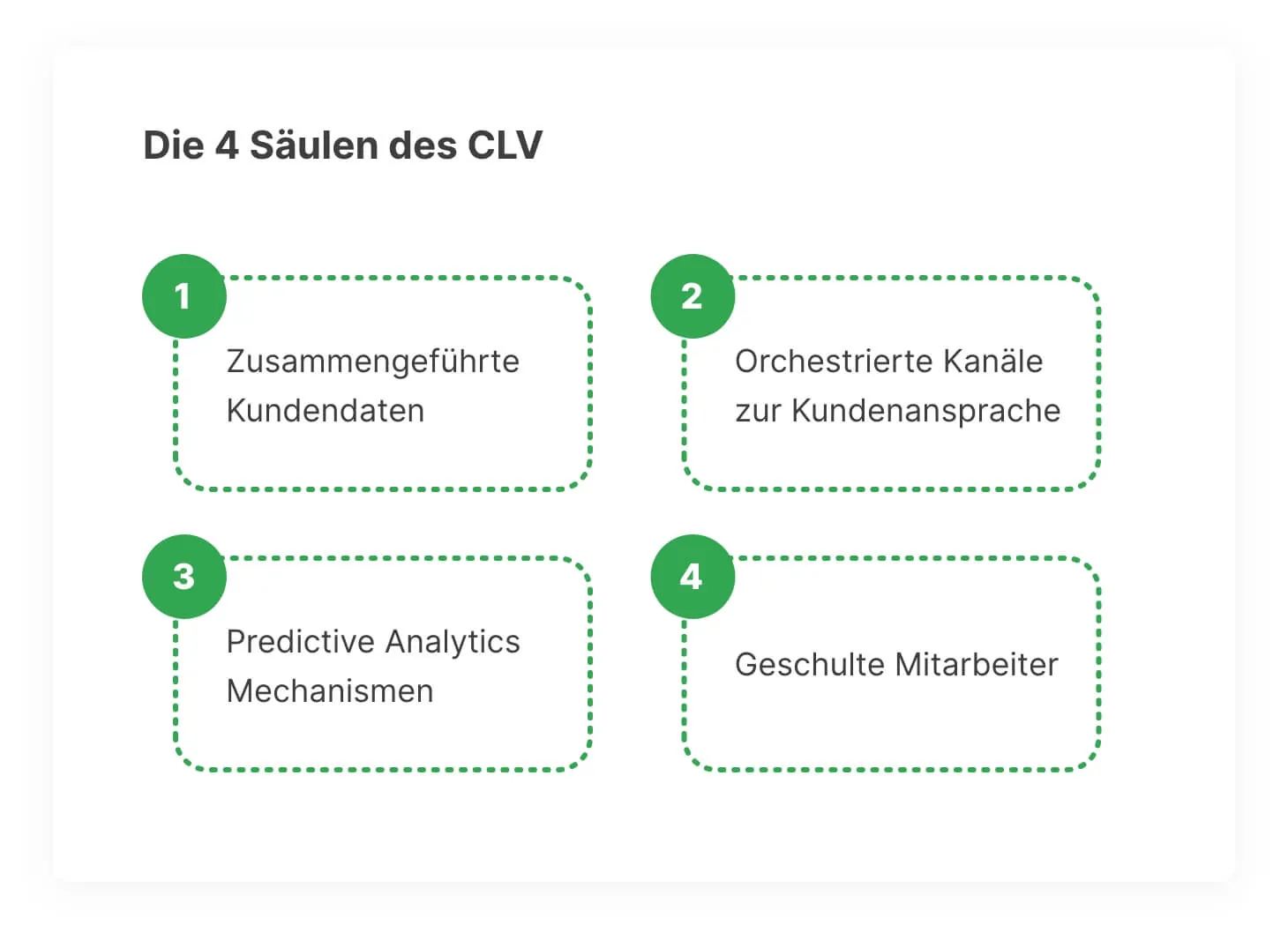
There is confusion around CLV, because it is calculated in different ways and many of them are simply wrong. Let's take a look at a few of the problems:
If you assume that you earn a profit of 100 francs with an average customer over a period of 12 months, when in reality you only make a profit of 75 francs, this has a significant impact on how much you can invest in marketing.
If someone asks you, "What is your LTV?", you shouldn't answer with a single number!
Because the calculation includes a time component and the answer can change over time, you must always provide context!
A correct counter-question would be: "For which group of people and at what point in time?"
After that, you can answer the question something like this: "For the customers we acquired last year who made it to checkout, our 1-year CLV is 40 francs."
When you understand your customer lifetime value, you gain a better overview of your e-commercebusiness in several important areas.
As you can see from the graphic below, improving CLV can also help you identify areas that need improvement and show what is already working well.
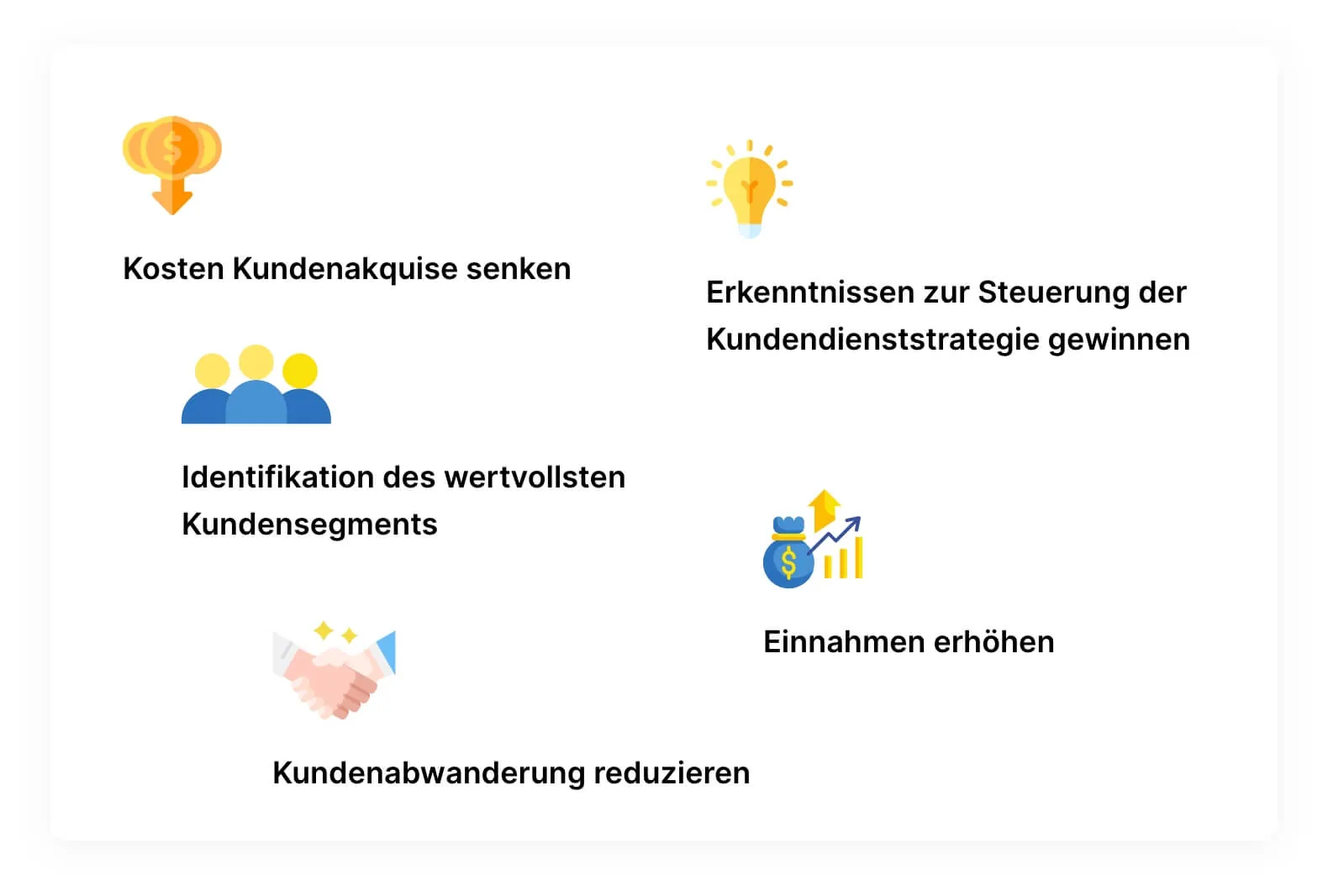
Here are some more reasons why CLV shouldn't be neglected for your e-commerce business.
Your CLV helps you understand which of your marketing measures lead to more revenue, reduce churn and extend the time your customers stay.
It can also help you decide how much attention to give the legendary conversion rate.
With the comprehensive overview that results from CLV analysis, you gain a better understanding of your customers' goals and timing.
You gain more clarity about the individual decision phases and can make smarter decisions to improve your ROI. You can also reduce acquisition costs, since you know which customers are worth your efforts.
Once you have measured your CLV, you know better how your customers behave and what value they have for you.
With this information, you can focus on small improvements in the areas that bring you more profit, such as usability or customer retention.
For example, if you introduce loyalty programs or offer excellent customer service - whether via chatbot or pop-up window - you can increase the average length of time customers stay loyal to your brand.
With CLV, you get a more detailed insight into the profitability of your customers and can thus create marketing campaigns aimed specifically at these customers.
You can also focus on winning new customers who have a similar profile to your most valuable customers.
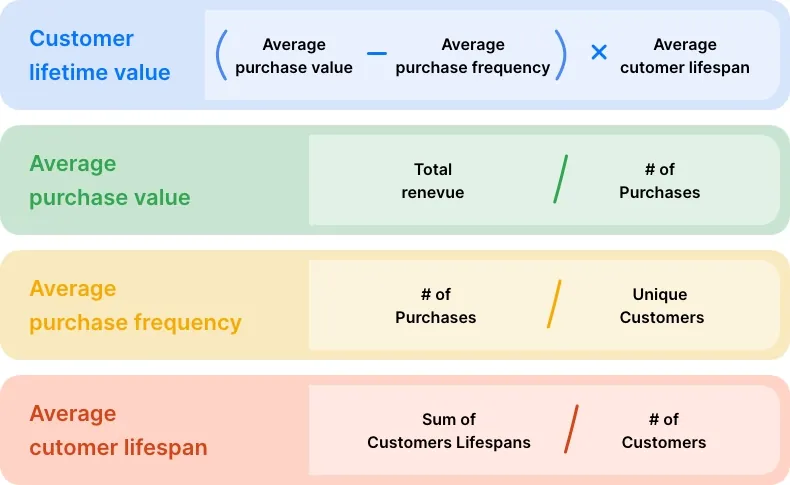
To determine your CLV, you first need a few metrics. The next graphic shows how to find them. You need:
Once you have these numbers, multiply the average order value by the average purchase frequency, and then by the average customer lifespan.
The formula looks like this:
AOV x APF x ACL = CLV
The ratio between customer lifetime value and the cost of acquiring customers, known as customer acquisition cost or CAC, is an important metric that you should know and monitor!
It shows whether your business earns enough money to offset acquisition costs over time.
The challenge is that your CAC keeps rising as advertising costs (along with other costs) increase.
So you have to work constantly to increase customer lifetime value in order to maintain a healthy LTV:CAC and a profitable business.
A typical benchmark for a healthy ratio is 3:1. This means that LTV is at least three times as high as CAC. Ideally, your LTV:CAC ratio should keep improving steadily over time.
Now that you know how CLV works, we will discuss some ways to increase customer lifetime value in E-Commerce .
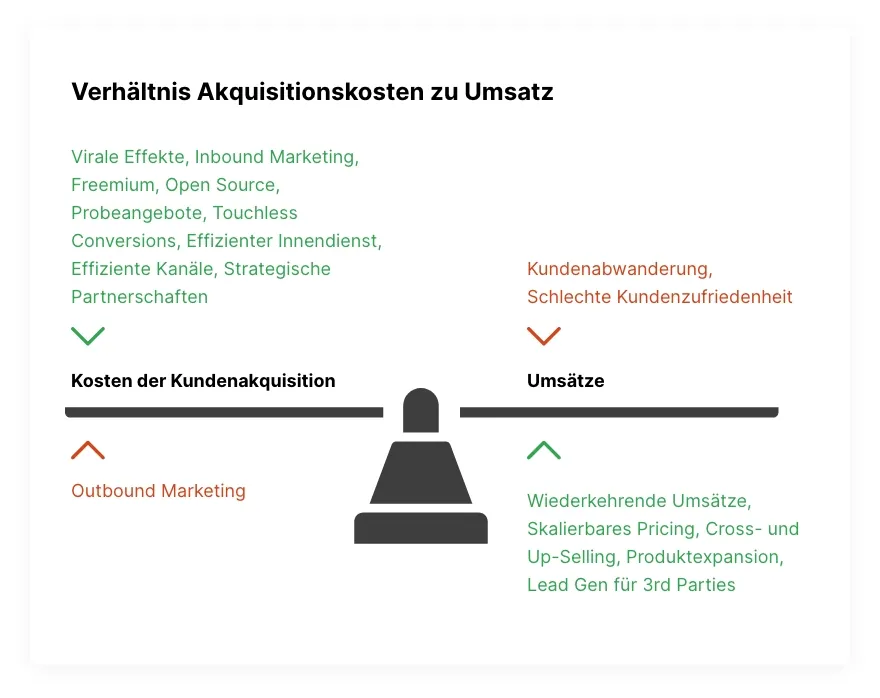
Improving customer lifetime value is ultimately about creating balance in your business model.
As the chart below illustrates, the goal is to offset the unavoidably high costs that inevitably come with running your business. The main task is to bring the relationship between the cost of acquiring new customers and revenue into a favorable balance. Professional E-Commerce SEO optimization can help here.
One of the fastest ways to increase customer lifetime value is to continuously improve the customer experience your business provides.
According to a PWC study, 43 percent of consumers are willing to pay more for a product or service if it offers a better experience. 75 percent of customers say that the customer experience and user experience of an online store play a decisive role when choosing between different purchase options.
It is the overall impression a customer gets after doing business with a company. This includes everything from product quality to customer service and payment options to the usability of the website. According to the PWC study mentioned above, these are the factors customers value most.
As an e-commerce business owner, you can improve
to create an unforgettable customer experience that directly increases your customer lifetime value.
You can also increase your customers' average order value by offering personalized product recommendations and promoting related products during checkout.
Loyalty programs are a popular way to keep customers with your business for longer and encourage them to shop more often at your e-commerce business.
There is no fixed model, as these programs come in all shapes and sizes. The basic idea, however, is to reward customers in different ways every time they buy your products.
This not only encourages them to buy more often, but also helps increase the average order quantity.
email marketing is one of the most profitable marketing and customer retention channels in e-commerce and delivers a high ROI. And the best part? Customers love receiving discounts and special offers by email.
But don't limit your communication to promotional emails!
To build a lasting relationship with your customers and increase their lifetime value, you should share tips and helpful content on using your products in a variety of innovative ways.
Stay on your customers' radar and reach out to them regularly with birthday wishes, event-specific emails and messages for special occasions, in addition to regular product updates.
We have introduced three popular methods you can use to get your customers to pay for your products more often. But there are many other ways to increase customer lifetime value.
If you have questions about increasing customer lifetime value in E-Commerce or need help developing a customer retention strategy, please reach out to us and get in touch here!
Increase the customer lifetime value of your e-commerce business with us as your Google Ads Agency and Online Marketing Agency Zurich at your side!
Increase customer lifetime value

Digital Marketer
Digital Marketer
We use cookies for statistics and advertising purposes. Settings