Data-Driven Strategies

Data-Driven Marketing

Illustration: Programmatic Advertising with Data, Devices, and Audiences

Integrating data-driven strategies into decision-making

Do you want to feed data-driven strategies into the decision-making for your marketing activities? After all, modern technology offers numerous ways to collect data. According to a report by the McKinsey Global Institute, companies now store over 200 terabytes of data!

But with so much data available to you, how do you decide which data is actually relevant? And how can this data be integrated into decision-making? 
Fire8, your Online Marketing Agency in Zurich, shows you in this article.

What is data-driven marketing?

Data-driven marketing enables companies to make marketing decisions based on industry, company and customer data. The main focus is on collecting and using information about consumers' needs, interests, preferences and behaviors. 

What types of data are used?

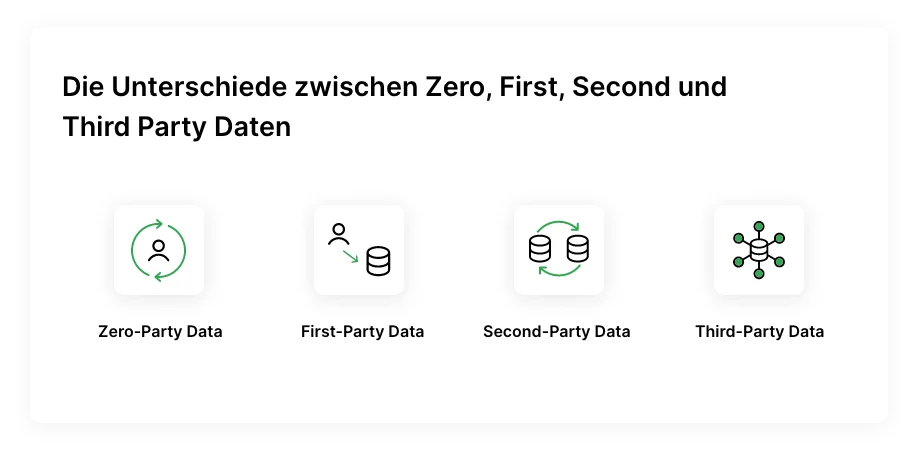
There are four different types of data used when integrating data-driven strategies into decision-making, depending on where and how they are obtained.

Zero-party data and first-party data capture customer information directly from brands.

Second-party data is sold by other organizations.

Third-party data is compiled from multiple external sources.

As the graphic below shows, consumer consent regarding the use of this data plays an important role in telling them apart.

Overview: differences between zero-, first-, second- and third-party data

Zero-party data: information that a consumer actively and voluntarily shares with a brand

First-party data: information that a company collects directly about consumers when they interact with the brand

Second-party data: data from another company that your company is permitted to use, secured by contractual agreements

Third-party data: information collected from a range of public and non-public sources that the consumer may not have explicitly provided.)

In which areas does data-driven marketing play an important role?

Used correctly, data should be present in every aspect of marketing and at every stage of the decision-making process.

By collecting, processing, distilling and analyzing this company-generated data, companies are able to:

  • predict future trends
  • adapt to customer expectations,
  • personalize the shopping experience,
  • improve sales and marketing performance,
  • increase ROI and
  • run more effective marketing overall.

So why wouldn't you use the power of data? Keep reading to find out how you can benefit from data-driven decisions in marketing!

Why is data-driven marketing so beneficial?

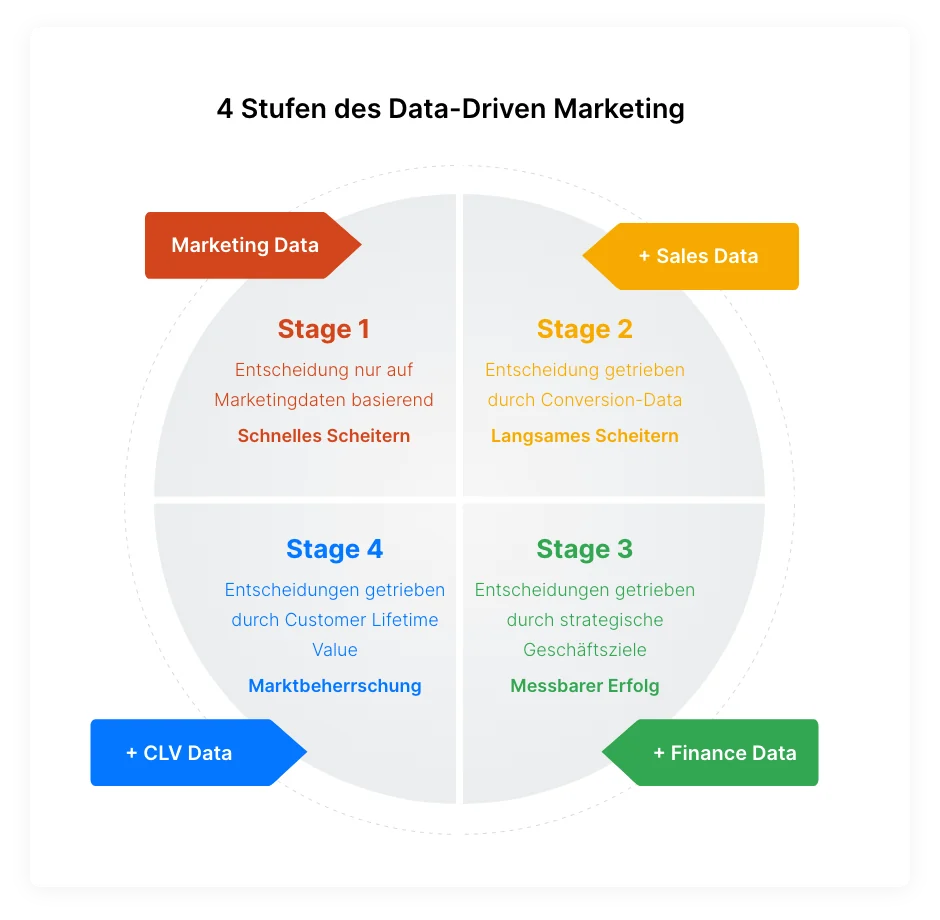
Collecting and organizing data and learning data analysis is a lot of work, as the graphic below also makes clear.

Diagram: the 4 stages of data-driven marketing

One of the main dangers is undoubtedly the evaluation of incomplete data sets. As the diagram shows, effective data-driven marketing is based on information from almost all areas of a company.

Despite everything, the benefits of data-based decision-making are more than worth the effort. Here are the most important reasons why data-driven marketing pays off for your company too.

Gain a better understanding of your customers

Assuming you know who your target audience is and what needs they have is usually a mistake. This is especially true when you probably have a considerable amount of customer data that you can use to understand them better.

You don't just have the information you've gathered from submitted forms, feedback or interactions with your marketing and sales staff. You can also use behavioral data to better understand what your customers are looking for.

Improve personalization

Customer data can be used to personalize your interactions, which helps build trust more effectively.

Based on the data you have about your customers, you can, for example, create detailed buyer personas to align your marketing measures with.

Your customer data can also be used in E-Mail Marketing to segment your email list and nurture your leads more effectively with personalized content."

You get a baseline for accurately measuring your efforts

Data lets you measure the results of your marketing activities over time. This allows you to compare the impact of different tactics. You can also tell whether or not results have improved over a certain period.

Your historical data and the ability to compare data enable you to make decisions based on whether results were good or bad, rather than on gut feeling and vague assumptions.

Manage your sales and marketing efforts effectively

Deciding where to invest your resources can be difficult without data. You want to be able to rely on your decisions.

Suppose, for example, you want to compare two different lead sources to decide which one to invest more in. If you don't apply data-driven decision-making, you will only compare the results. These can be misleading, however, and don't always tell the whole story.
Data-driven marketing has never been easier than it is today. Start your project inquiry here.

Get complete insight

Perhaps the first lead source brings in 20 percent of customers, while the second brings in 35 percent. At first glance, it seems most sensible to invest resources in the second lead source, since it attracts the most customers.

If you look at the data more closely, however, you will find that although the second lead source converts more customers, it costs on average 50'000 francs more per year than the first lead source.

If you base your decision on data, you can calculate which lead source brings you the greater ROI.

Data is an unassailable source for change

When marketing or sales results fall short of expectations, changes are often required.

Without data, you are forced to guess which changes you should make. You have to hope that you guessed right.

With data, you can determine what is causing poor results and make decisions that actually fix the problems. 

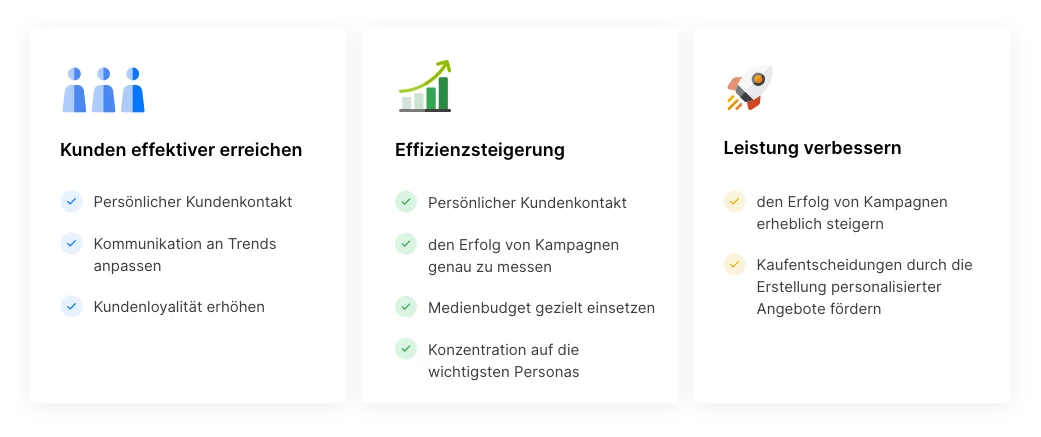
Data-driven marketing brings many benefits

The following image once again impressively illustrates the many benefits of data-driven marketing, which can be summarized at their core as follows.

You reach your customers more effectively. 

You improve the performance of your marketing campaigns .
You reduce effort by increasing efficiency.
Benefits of data-driven marketing: reach customers more effectively, increase efficiency, improve performance

Challenges of data-driven decision-making in marketing

Relying on your data to make better decisions inevitably brings a number of challenges.

These challenges can lead you to make poorer decisions, which can have a negative impact on your marketing and sales tactics.

We have therefore compiled some of the most common challenges in data-driven marketing.

Integration, engagement and prioritization

Data-driven marketing requires a significant investment of time and resources.

Some companies therefore fail to prioritize integrating data into their marketing strategies. For example, they look only at website traffic or financial KPIs to measure performance, instead of capturing information at every stage of their customers' user journey . 

Brands must consider all touchpoints with users, from advertising on social media and email to the website and app, and of course contact through personal interactions.

Data quality and accuracy

The effectiveness of the data collected depends on its quality, accuracy and relevance.

If the information does not meet the six dimensions of data quality (accuracy, completeness, consistency, timeliness, validity and uniqueness), marketers may draw the wrong conclusions.

Companies must therefore establish clear data collection practices and policies to make sure they are on the right track!

Decision paralysis

Companies may also wrongly give quantity priority over quality. They collect a large amount of information that is not actually relevant.

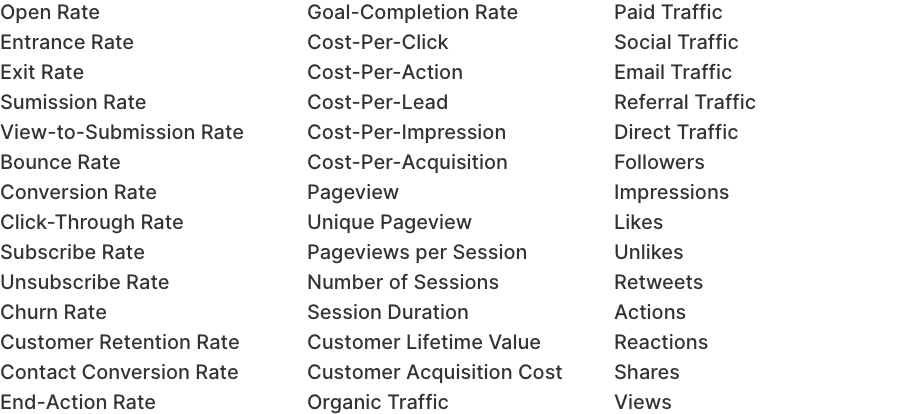
The art of efficient data-driven marketing is to filter out the right sources and put them in an appropriate context. The following graphic shows an excerpt of possible sources for data-driven decisions in marketing.

List of marketing metrics such as open rate, conversion rate, cost per click and customer lifetime value

Privacy concerns

Governments, organizations and users regularly express concern about data protection, transparency and control of data.

Customers are particularly vigilant when it comes to how companies collect, use or even sell their data. As a result, data protection laws have come into force. 

To reduce legal risks, companies should focus on collecting zero-party and first-party data, which are gathered with the explicit consent and understanding of consumers!

Success with data-driven marketing

Data-driven marketing with Digital Analytics can help monitor the performance of marketing and sales strategies, identify patterns and trends, and make confident decisions quickly and proactively.

That is why it is worth investing time and effort in implementing a reliable process for collecting, cleaning, analyzing and visualizing data.

Our Industry Solutions

Data-Driven Marketing

Boost your marketing success with data-driven strategies.

*
*
*
*
What is it about?
Samuel, Digital Marketer at Fire8, with tablet

Samuel

Digital Marketer

Samuel

Digital Marketer