How important is the Page Experience for SEO?
The page experience is what users think about their interaction with our websites. It includes:
Optimization for mobile devices,
no intrusive interstitials (the ads that pop up on mobile phones and cover the entire screen),
A good page experience does not take precedence over relevant content. However, in cases where there are several pages with similar content, the page experience becomes much more important for visibility in search results.
The bottom line? We need to have great content. But if our content is similar to someone else's, the page experience will be the tiebreaker that determines who ranks higher.
How can I optimize the LCP?
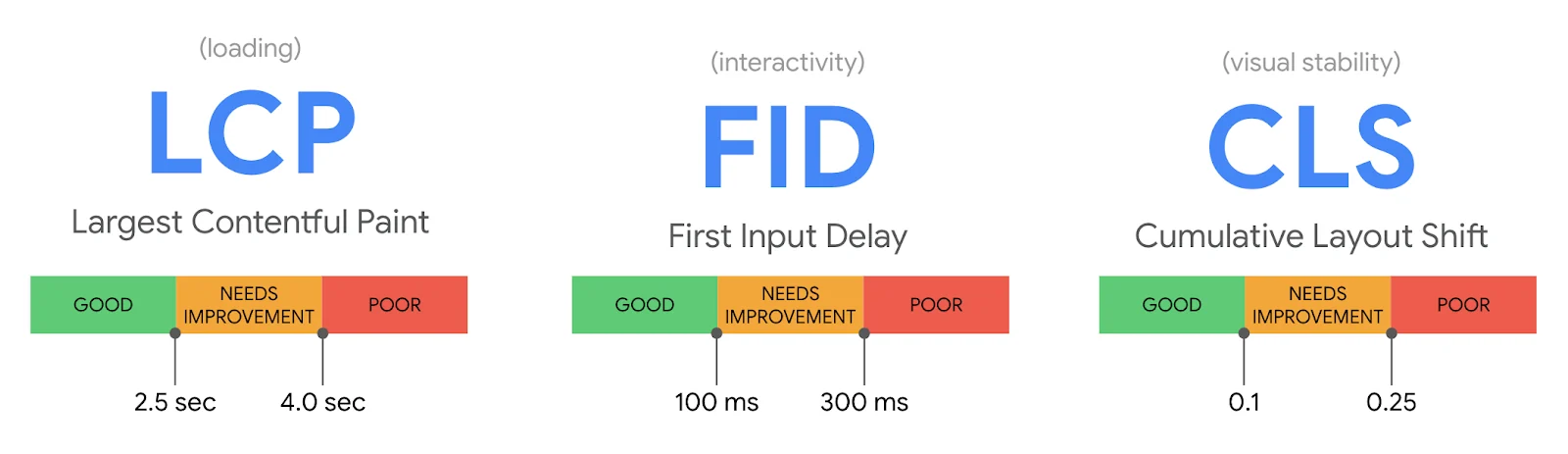
As mentioned, the LCP measures the time that passes from the click on your website until the main content is displayed on the screen. As such, this metric affects your page load speed, which is influenced by the render time of the largest image, video, or block of text on your website.
Keep in mind that a load time of under 2.5 seconds is considered good! Anything above that needs to be improved, and if your website loads more slowly than four seconds, Google rates it as poor.
What causes slow load times and how do you fix them?
One of the following problems could be the cause of slow load times:
Slow server response times. This can be caused by poor web hosting, missing caching, increased web traffic, and other factors
Files that prevent websites from displaying content before they have fully loaded.
Client-side rendering, since these types of websites create dynamic routes directly in the browser.
Here are some tips for fixing problems with slow load times:
Remove all unnecessary third-party scripts (plugins)! They may not be optimized and can slow down your website.
Upgrade your web hosting! Cheap hosting could tie your site to slower web servers and therefore slower load times.
Set up "lazy loading" or use a content delivery system! This makes it easier to cache your website, and the content is sent via data centers close to the users. All of this contributes significantly to shorter load times.
Remove large web page elements!
Serve HTML pages from the cache first!
Establish connections to third-party providers early!
Optimize and compress images!
Make sure your web pages are AMP-optimized!
Can the FID be optimized as well?
As part of the Core Web Vitals, the First Input Delay measures how quickly the page becomes interactive. In other words: when the user clicks on something for the first time, how long does it take until something happens?
This metric may be less relevant for blogs or news sites, where the central interactivity involves opening articles to read. But for websites that include logins and/or sign-up pages, the FID is crucial.
Pages with an FID of more than 300 ms are considered poor. Ideally, you should be under 100 ms for this metric. You may be able to improve this value with the following measures:
Breaking up long tasks and minimizing JavaScript bloat.
Removing unnecessary third-party scripts.
What's the deal with the CLS?
The Cumulative Layout Shift (CLS) is about whether your web page elements stay in the right place while the site loads. It measures the sum of unexpected layout shifts. A layout shift occurs every time a visible element changes its position between rendered frames.
Have you ever tried to click on something on a mobile website, but the element shifted just as you were about to select it? Chances are the website had an undesirably high CLS value.
Anything below 0.1 is good. If you reach a value of more than 0.25, the visual stability of your website urgently needs to be improved! Here are a few fixes you can apply:
Define media size attributes in HTML so that web browsers know how much space they will take up!
Work with responsive images!
Some fonts can cause blurry or invisible text while rendering. Test this and make changes if necessary!
Use transform animations instead of property animations! The latter are more likely to trigger layout changes!
Why is this important for my website?
Modern users don't want to wait for a website to load to get the information they are looking for. We now know that Google's goal is not only to show the most relevant result for a search query, but also the fastest.
You will no longer be able to rank well if your page speed and other user experience metrics are poor. This shift toward prioritizing usability, together with existing ranking factors such as Content Marketing and link building, will drastically change the way website operators think about SEO .