Make your website an excellent host
Have you ever missed an important event because you arrived too late? That can be very frustrating. Visitors to your website feel similarly when it loads too slowly. There is a risk that they become impatient and switch to a competitor before they have even had the chance to take in your content.
But don't worry, our SEO Agency in Zurich knows the solution to this problem: effective page speed optimization. With the right techniques, you can ensure that your website is always an excellent host that serves its guests quickly and meets their needs.
Here you will learn how to turn a website into a fast-loading, user-friendly platform. Let's impress your visitors together and make sure your website is always worth a visit!
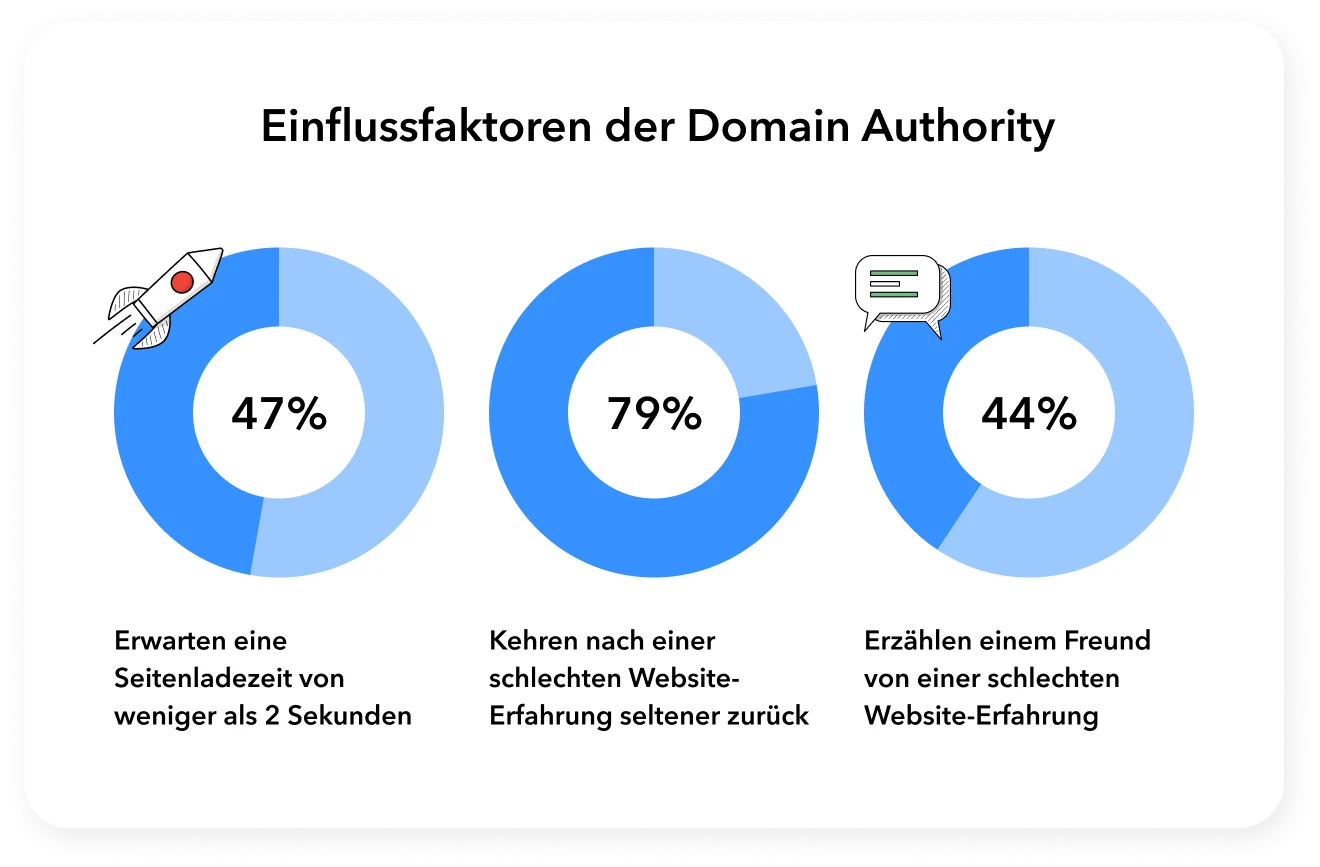
Loading speeds can significantly affect the success of a website. Surveys show that almost half of all internet users expect a web page to load in two seconds or less. A similar share of users leave a web page if it takes more than three seconds to load. Here are some more interesting findings that studies and surveys on page speed have produced:
Human or machine - everyone wants page speed
In addition, page speed is a crucial factor in search engine algorithms, which means that slow-loading websites are likely to rank lower in search results. Now that we know how important page speed optimization is, let's discuss how you can achieve it.
Do you have images on your website?
Images are often one of the main causes of slow loading times. Our Online Marketing Agency can optimize your images by reducing file sizes, compressing image files and using the right file types. This can significantly shorten the loading time of the images on your website.
Do you like standing in line?
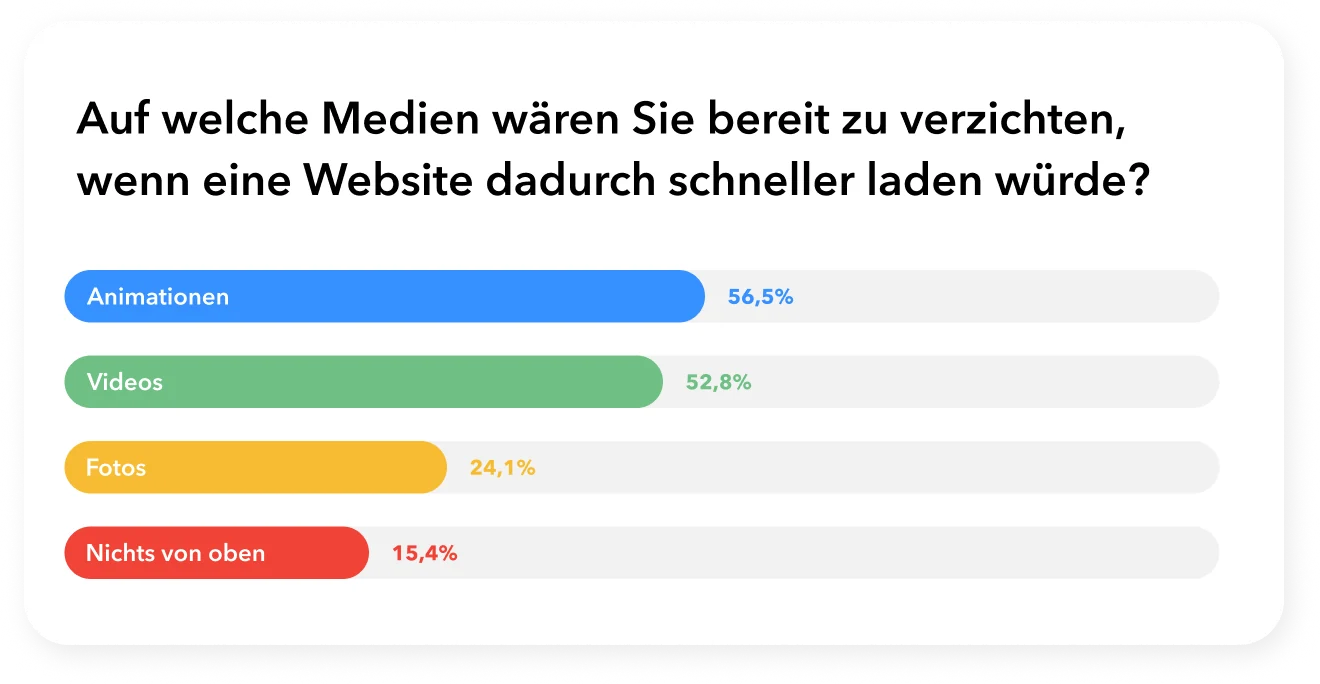
Your website visitors certainly don't. Every time a browser loads a web page, it makes several HTTP requests for resources such as images, scripts and stylesheets. That is why minimizing HTTP requests is an effective method of page speed optimization. Take a look at the results of the following survey. For example, more than half of respondents would be fine with giving up videos and animations entirely if it improved loading time. That speaks volumes.
Question: Which media would you be willing to give up if it made a website load faster?
How can HTTP requests be reduced?
This can be achieved, for example, by combining several small files into larger files. So-called CSS sprites also make it possible to combine several images into a single image. We can also help you minimize HTTP requests, for example by merging several files into a single file, reducing the number of images or videos on a page and minimizing the use of external scripts.
What happens behind the curtain?
A website is similar to a theater performance. A spectator in the audience, just like a website visitor, has no idea what is going on in the background to ensure a good performance. The stagehands who make sure all the trapdoors are closed and the props are in the right place are the lines of code that make it possible to display a website. We optimize your website's code by removing superfluous lines or redundancies, minimizing the use of external scripts and plug-ins as well as the size of CSS and JavaScript files, and by adapting the code to the specific needs of your website.
Server optimization for a better user experience
Optimizing the server on which your website is hosted can be an important factor in improving your website's loading time. A well-configured server can speed up the transfer of files, for example by using a fast connection and effective compression techniques. In addition, server optimization can help increase the availability of your website and reduce downtime. By reducing delays and improving your server's response times, you can not only improve the user experience but also positively influence your website's ranking in search engines.
Are you using a content delivery network?
A content delivery network is a network of servers distributed around the world that are used to store and deliver website content. The advantage of these networks is that they cache a website's static resources, such as images and CSS files, on several servers in different regions. When a user accesses a website, the static resources are delivered from the nearest server, which shortens the website's loading time. In this way, a website's loading speed can be improved by serving the content from the server closest to the user.
Do you use browser caching?
Browser caching allows a web browser to store frequently used resources on the user's device so that they do not have to be downloaded again on later visits to the website. By using browser caching, a website's page speed can be improved, especially for returning visitors. This can be achieved by specifically adjusting the HTTP response of the website resources.
Are you using a lean theme?
A heavy, resource-intensive design can slow down a website's loading time considerably. You might want to switch to a lightweight theme with optimized code. Using a minimalist design with a limited number of graphics can also improve a website's performance.
Is Gzip compression enabled?
Gzip compression is a technique for compressing data before it is sent from the server to the browser. Enabling Gzip compression can significantly reduce the size of the data to be transferred and thus improve the speed of a website. This can be achieved by adding a few lines of code to the .htaccess file or by using a plug-in.
Would you drive a Ferrari that has no steering wheel?
Page speed is undoubtedly important. But what good is excellent speed if the content is poor or the user experience drives your website visitors to despair? Our team from the Search Engine Optimization would therefore like to close this article by focusing on a topic that should be considered in any page speed optimization effort: the user experience in terms of the so-called Google Core Vitals. It is a widespread misconception that page speed and Core Web Vitals are the same topic. We would like to clear this up below.
What is the difference between page speed optimization and Core Vitals…
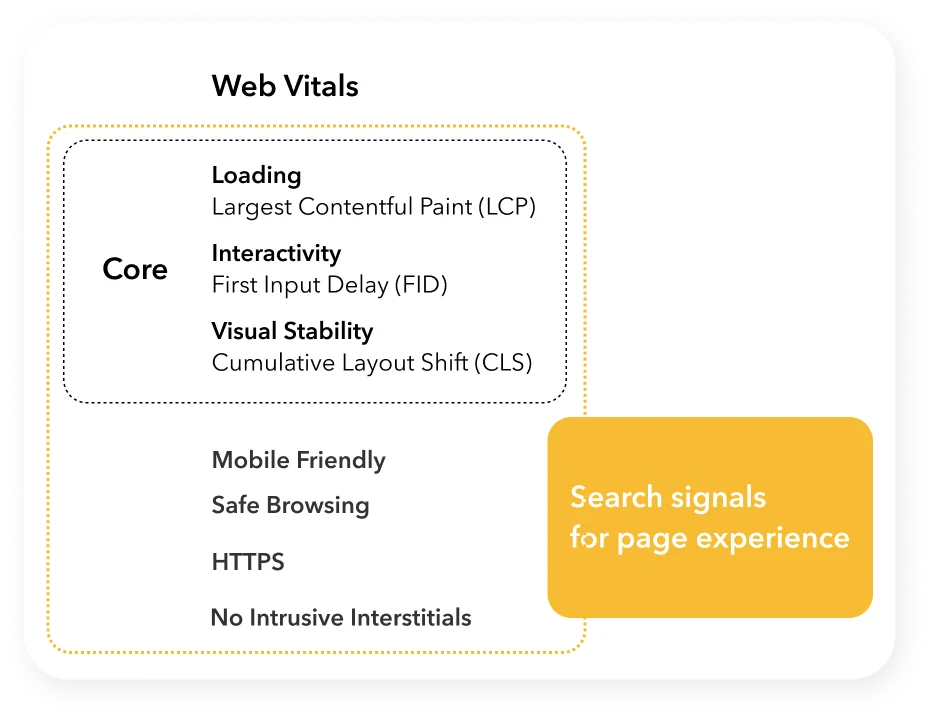
The Core Web Vitals are a set of metrics for measuring the user experience on the web. They relate to speed, responsiveness and visual stability. The following graphic shows the individual Web Vitals.
All Web Vitals make up the page experience, by which Google sorts search results, with the Core Web Vitals carrying the most weight.
… and why does this difference matter?
Page speed optimization is undoubtedly an important part of the overall user experience within the Core Web Vitals. The problem is that you can have the fastest-loading website on the entire internet. If the other Web Vitals criteria are only inadequately met, however, it will not bring you many advantages in search engine rankings. If, on the other hand, you meet the Web Vitals requirements, even if page speed is not optimal, this will be rewarded with a better ranking.